If you’ve been on social media lately, scrolled through beauty forums, or walked down the skincare aisle of any store, you’ve probably noticed one undeniable shift: Korean skincare is absolutely everywhere. And honestly? There’s a very good reason for that.
It started as a niche obsession among beauty enthusiasts but has evolved into a full-blown global movement. From New York to Mumbai, Paris to Manila — millions of people have ditched their old three-step routine and embraced the thoughtful, methodical world of K-beauty skincare. And if you’re reading this, chances are you’re ready to understand what the hype is all about.
Here’s what sets Korean skincare apart from everything else you’ve tried: it doesn’t treat skin problems after they appear. Instead, it works to prevent them in the first place. The philosophy is rooted in long-term skin health — the idea that consistent, gentle care done daily will outperform aggressive treatments every single time. Think of it less like a beauty regimen and more like a daily ritual of self-care that your skin genuinely needs.
The results speak for themselves. Korean men and women are famous worldwide for their enviably clear, smooth, almost luminous skin. That “glass skin” look — dewy, bouncy, and practically transparent in its clarity — isn’t achieved overnight or through heavy foundation. It’s the result of years of dedicated skincare built around hydration, layering, and patience.
In this complete guide, we’re breaking down the famous Korean 10-step skincare routine — every step, every product type, and every expert tip you need to start your own K-beauty journey. Whether you’re a total beginner or someone who already has a few products on their shelf, this article will help you understand the method behind the magic. We’ll also cover the science behind skin hydration, the best ingredients to look for, common mistakes to avoid, and how to customize your routine for your specific skin type.
Ready to glow? Let’s get started.
Why Korean Skincare Became So Popular Worldwide
To understand why K-beauty has taken the world by storm, you have to understand the core philosophy behind it. Korean skincare isn’t just a set of products — it’s a completely different approach to skin health. And that approach turns out to resonate deeply with people everywhere, regardless of skin tone, climate, or age.
Prevention Over Correction
Western beauty culture has historically focused on covering up skin issues or treating them aggressively once they appear. Korean beauty culture flips that entirely. The goal is to maintain healthy, balanced skin so that problems don’t arise in the first place. Sunscreen is worn daily — not just at the beach. Gentle cleansing happens twice a day. Hydration is a non-negotiable priority. This prevention-first mindset resonates strongly with anyone tired of chasing quick fixes that never quite work. According to the American Academy of Dermatology, consistent sun protection and daily moisturizing are among the most evidence-backed practices for long-term skin health — which is exactly what K-beauty has always championed.
Hydration as the Foundation of Everything
If Korean skincare had a single guiding principle, it would be this: hydrated skin is healthy skin. Every step in the K-beauty routine in some way supports the skin’s moisture levels. Toners hydrate, not astringent. Essences hydrate. Serums hydrate. Even the sheet masks are essentially a concentrated burst of moisture. This hydration-first philosophy is radically different from the stripping, drying, and over-exfoliating that many people were taught was “normal” skincare. Your skin barrier, it turns out, absolutely thrives when kept consistently well-hydrated.
Lightweight Layering — The Art of Building Moisture
Instead of applying one heavy cream and hoping for the best, Korean skincare builds moisture in layers. Each product is lighter than the next, allowing the skin to absorb hydration gradually and thoroughly. This approach is especially effective because it doesn’t overwhelm the skin or clog pores — a common complaint with thick Western moisturizers. The layering system also means you’re delivering multiple beneficial ingredients to your skin, not just one.
Innovative Ingredients That Changed Everything
Korean beauty brands have introduced the world to ingredients that most Western companies hadn’t even considered: snail mucin, fermented rice water, propolis, sea buckthorn, and centella asiatica, to name just a few. These aren’t gimmicks — many of these ingredients have strong dermatological research behind them. Korean cosmetic laboratories invest heavily in skincare science, producing formulations that are often years ahead of Western counterparts.
The K-Pop and K-Drama Effect
Let’s be honest — the global rise of Korean pop culture has played an enormous role in spreading K-beauty worldwide. Seeing the flawless skin of BTS members, the luminous complexions of Korean actresses, or the glass-skin looks of K-drama stars on Netflix has made millions of fans ask: “What are they using?” Social media made it instantly possible to find the answer, and suddenly, Korean beauty brands had a global audience eager to try everything they offered.
Gentle Methods for Sensitive Skin
K-beauty’s commitment to gentle, non-irritating skincare has been a revelation for people with sensitive or reactive skin. While some Western skincare trends promoted high-concentration retinols, strong AHAs, and abrasive scrubs, K-beauty defaults to low-irritant formulas, soothing botanicals, and gradual introduction of actives. For people whose skin has been damaged by harsh products, Korean skincare often feels like a genuine recovery journey.
The Complete 10-Step Korean Skincare Routine (2026 Guide)
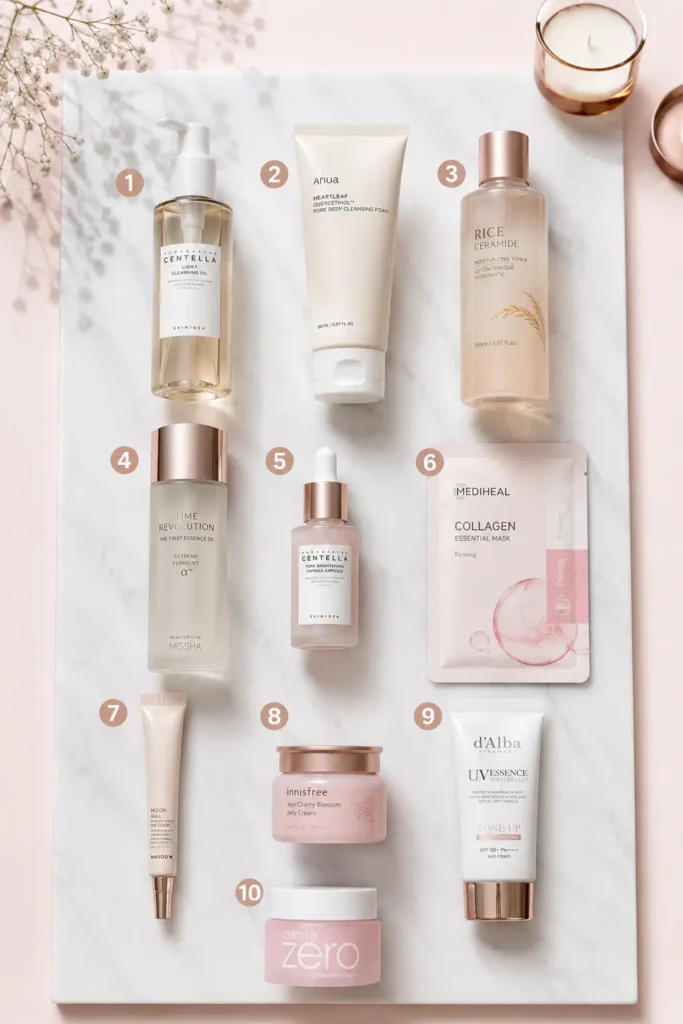
The 10-step Korean skincare routine isn’t something you need to do every single day in its entirety — we’ll explain the morning vs. night approach later in this article. Think of these 10 steps as the full toolkit, and you’ll learn to pick the right tools for each occasion. Here’s a full overview before we dive into each step:
| Sr. | Step | Purpose | AM or PM? |
|---|---|---|---|
| 1 | Oil Cleanser | Removes makeup, sunscreen, excess sebum | PM (Essential), AM (optional) |
| 2 | Water-Based Cleanser | Deep-cleans pores, removes residue | AM + PM |
| 3 | Exfoliator | Removes dead skin cells, brightens texture | 2–3x per week (PM) |
| 4 | Toner | Balances pH, adds first hydration layer | AM + PM |
| 5 | Essence | Lightweight hydration, skin-health booster | AM + PM |
| 6 | Serum/Ampoule | Targets specific concerns (acne, pigmentation, aging) | AM + PM |
| 7 | Sheet Mask | Intensive hydration and nourishment treatment | PM (2–3x per week) |
| 8 | Eye Cream | Hydrates delicate under-eye area | AM + PM |
| 9 | Moisturizer | Seals in all hydration, protects skin barrier | AM + PM |
| 10 | Sunscreen | Protects against UV damage and premature aging | AM (Non-negotiable) |
Step 1: Oil Cleanser — The First Cleanse
Think of your oil cleanser as a magnet for everything that shouldn’t be on your face at the end of the day. Makeup, sunscreen residue, pollution particles, and excess sebum — all of these are oil-based, and oil dissolves oil. That’s the simple science behind why every Korean skincare routine begins here.
A good oil cleanser — whether it comes as a balm, cleansing oil, or micellar-style formula — should emulsify when it meets water, turning milky and rinsing away cleanly without leaving a greasy film. The experience should feel luxurious: massaging an oil cleanser over your face for 60 seconds is genuinely one of the most satisfying parts of a PM routine.
Best product types: Cleansing balms, cleansing oils, lightweight micellar oils. Look for formulas with jojoba, sunflower, or rice bran oil.
Common mistake: Using waterproof mascara remover as a substitute. It’s not the same — a proper oil cleanser also cleanses pores and preps skin for the next steps in a way that spot-removers don’t.
Step 2: Water-Based Cleanser — The Double Cleanse
The concept of double cleansing is one of Korea’s greatest contributions to global skincare culture. After the oil cleanser handles oil-based impurities, a water-based cleanser swoops in to remove any remaining water-based residue — sweat, environmental pollutants, and leftover bits of cleanser itself. The result is a truly clean, balanced canvas for everything that comes after.
The key word in Korean water-based cleansing is gentle. You’re not trying to strip the skin — that would disrupt the moisture barrier you’re working so hard to protect. Look for low-pH formulas (around pH 5–6, close to your skin’s natural pH of 4.5–5.5). High-pH cleansers, while creating a satisfying “squeaky clean” feeling, can actually disrupt your skin’s acid mantle and lead to dryness, irritation, and breakouts.
Best product types: Gel cleansers, foam cleansers, cream cleansers (for dry/sensitive skin). Brands like COSRX, Innisfree, and Banila Co. make excellent options.
Step 3: Exfoliator — Clear the Path
Exfoliation in Korean skincare is a very different conversation than in Western beauty culture. Forget the rough, gritty scrubs your mother used to swear by. K-beauty exfoliation is almost always chemical — meaning it uses gentle acids or enzymes to dissolve the bonds between dead skin cells, allowing them to shed naturally without any physical abrasion.
AHAs (alpha-hydroxy acids) like glycolic and lactic acid work on the surface to improve texture, brightness, and fine lines. BHAs (beta-hydroxy acids) like salicylic acid penetrate into pores, making them ideal for oily or acne-prone skin. PHAs (polyhydroxy acids) are the newest and gentlest option, perfect for sensitive skin types who want the benefits of exfoliation without the potential irritation.
How often: 2–3 times per week, always in your PM routine. Over-exfoliating is one of the most common mistakes beginners make, and we’ll cover that in detail later in this article.
Step 4: Toner — The pH Balancer and Hydration Primer
If you’ve only ever known Western astringent toners — the kind that sting, smell like alcohol, and make your skin feel tight — prepare to have your mind completely changed. Korean toners are a revelation. They are hydrating, soothing, and skin-prepping, not stripping. Their job is to rebalance your skin’s pH after cleansing and deliver the first layer of hydration before the richer products that follow.
Many Korean toners are applied in multiple layers — a technique sometimes called “7-skin method” in K-beauty circles, where you apply 5–7 thin layers of toner for deeply plump, hydrated skin. You don’t need to go that far, but applying two layers of a hydrating toner makes a noticeable difference in how smooth and receptive your skin feels.
Best product types: Hydrating toners with hyaluronic acid, glycerin, or centella asiatica. Look for watery, fast-absorbing formulas. Apply by patting into skin with your palms rather than wiping with a cotton pad — this reduces waste and is more effective.
Check out our guide on natural ways to tackle dry skin problems if your skin tends to be dehydrated even after toning.
Step 5: Essence — The Heart of K-Beauty
If there’s one product that is uniquely, irreversibly Korean in the world of skincare, it’s the essence. Essences sit in a curious middle ground between a toner and a serum — lighter than serum but more concentrated than toner. They deliver a targeted blend of active ingredients — often fermented extracts, hyaluronic acid, or niacinamide — in a watery, fast-absorbing format that the skin drinks up eagerly.
The SK-II Facial Treatment Essence is perhaps the most famous example globally, with its cult following built entirely on the results it delivers. But you don’t need to spend a fortune — many mid-range essences from brands like MISSHA, Some By Mi, or COSRX deliver comparable results at a fraction of the price.
How to use: After toner, while skin is still slightly damp. Pat it gently into skin using both palms pressed together. Don’t rub.
Step 6: Serum or Ampoule — Your Targeted Treatment
If the essence is about overall skin health, the serum is where you get specific. What’s your main concern? Hyperpigmentation? A vitamin C or niacinamide serum. Fine lines and loss of firmness? Retinol or peptide serum. Persistent breakouts? A salicylic acid or centella serum. Dullness? Arbutin or tranexamic acid. Korean serums are formulated to address precise skin concerns with a higher concentration of active ingredients than any other step in the routine.
An ampoule is essentially a supercharged serum — used either short-term as a treatment course (for example, using a brightening ampoule every evening for 2 weeks before a big event) or as a booster mixed with your regular products. They’re concentrated powerhouses and a little goes a very long way.
Layering tip: If you use multiple serums, apply from thinnest consistency to thickest. Give each 30–60 seconds to absorb before the next.
Step 7: Sheet Mask — The Weekly Hydration Ritual
Sheet masks are perhaps the most photographed element of the Korean skincare routine — those white cellulose or bio-cellulose sheets soaked in concentrated serum, sitting on faces across thousands of Instagram stories worldwide. But they’re more than a social media prop. Used correctly 2–3 times per week, a sheet mask delivers an intense hit of hydration and active ingredients that your regular products simply can’t match in intensity.
The mechanism is clever: the sheet creates a temporary occlusive barrier that prevents the serum from evaporating, forcing it to penetrate deeper into the skin instead. Twenty minutes under a sheet mask can leave your skin looking visibly plumper, calmer, and more radiant.
Key tips: Never leave a sheet mask on until it dries out — that actually draws moisture back out of skin. Remove while it’s still slightly wet (around 15–20 minutes). Pat remaining serum into skin after removing. No need to rinse.
⭐ Editor’s Favorite K-Beauty Product: Sheet Masks
Look for sheet masks with bio-cellulose material (derived from coconut fermentation) rather than cheap paper sheets — they adhere better to facial contours and deliver ingredients more effectively. Brands like Mediheal, Dr.Jart+, and Benton consistently deliver exceptional quality sheet masks at accessible price points.
Step 8: Eye Cream — Gentle Care for Delicate Skin
The skin around your eyes is genuinely different from the rest of your face — it’s thinner, more delicate, has fewer oil glands (making it more prone to dryness), and moves constantly throughout the day with every expression you make. This is why it shows signs of aging first and why it deserves its own dedicated product.
Korean eye creams are formulated to be extremely gentle, non-irritating, and specifically targeted at the under-eye area. Look for ingredients like peptides (which support collagen production), caffeine (which reduces puffiness by constricting blood vessels), niacinamide (for brightening dark circles), and of course, hyaluronic acid for hydration.
Application tip: Use your ring finger to gently tap (never rub) eye cream along the orbital bone — not directly under the eye. Your ring finger naturally applies the lightest pressure. Apply in a C-shape from the inner corner to the outer corner, up along the brow bone.
Age to start: The earlier, the better. Many K-beauty advocates start using eye cream in their early twenties as a preventive measure — and it genuinely pays off over time.
Step 9: Moisturizer — Lock It All In
After all those beautiful layers of hydration, your moisturizer is the last line of defense — a seal that locks everything in and prevents transepidermal water loss (TEWL). Think of it like clingfilm over a bowl of salad: it doesn’t add anything new, it just keeps what’s there from escaping.
Korean moisturizers come in every weight and texture imaginable: gel-creams for oily skin, rich creams for dry skin, water creams for combination skin, sleeping masks for nighttime repair, and lightweight emulsions for those who want something between a toner and a cream. This variety is one of K-beauty’s greatest strengths — there is genuinely something for every skin type and every season.
Look for: Ceramides (to repair and strengthen the skin barrier), shea butter or squalane (for dry skin), hyaluronic acid and aloe (for oily/combination), and centella asiatica or madecassoside (for sensitive or acne-prone skin).
Also check out our article on nourishing skin with natural ingredients for additional barrier-repair ideas you can incorporate into your routine.
Step 10: Sunscreen — The Most Important Step of All
Here it is — the step that Korean skincare professionals, dermatologists, and beauty editors universally agree is the single most impactful thing you can do for your skin. If you skipped every other step in this routine and only kept one, sunscreen would be the one to keep.
Sun damage is responsible for up to 90% of visible signs of premature skin aging, according to the American Academy of Dermatology. Wrinkles, hyperpigmentation, uneven texture, loss of elasticity — most of it comes from UV exposure. All those serums and essences you’re layering are working beautifully to improve your skin, but UV rays undo their work every single day you step outside without protection.
Korean sunscreens are in a class of their own. They’re lightweight, non-greasy, and actually feel pleasant to wear — a far cry from the thick, white-cast formulas that have historically put people off daily SPF. Look for PA++++ rating (which indicates high UVA protection) alongside SPF 50 for comprehensive coverage.
Reapplication: For maximum protection, reapply every 2 hours when spending extended time outdoors. Sun-setting sprays and cushion sunscreens make this easy without disturbing makeup.
Best Korean Skincare Ingredients Explained
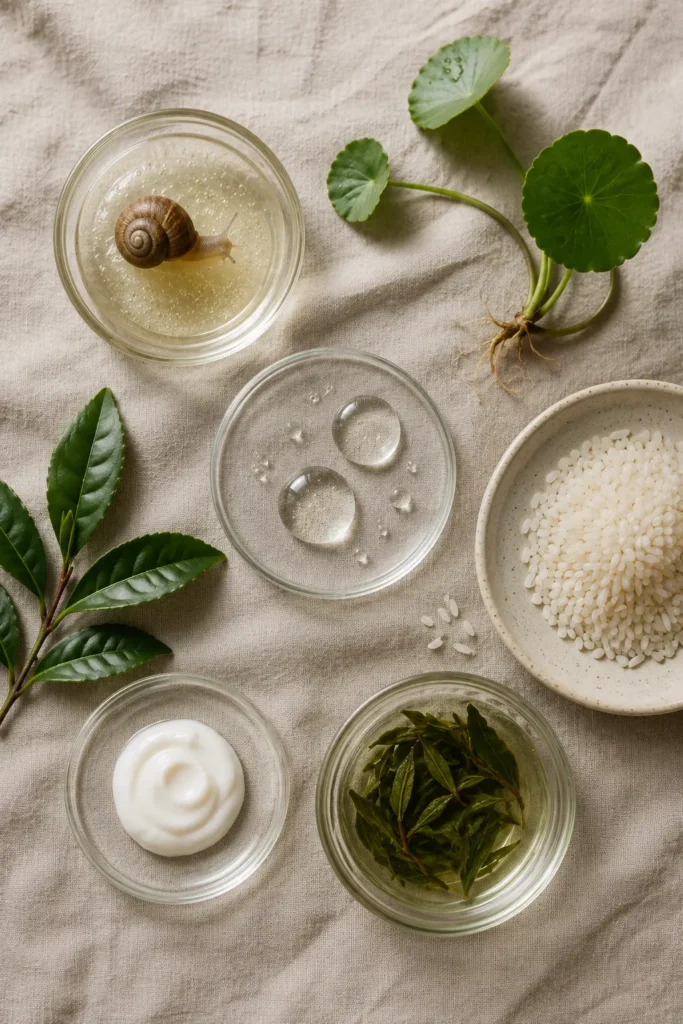
One of the things that makes Korean skincare so effective is the quality and variety of ingredients used. Here are the most celebrated K-beauty ingredients and what they actually do for your skin:
💧 Hyaluronic Acid
Can hold up to 1000x its weight in water. Draws moisture from the environment into skin for lasting hydration. Suits all skin types.
🐌 Snail Mucin
Rich in glycoproteins, hyaluronic acid, and zinc. Helps repair skin, fade acne scars, and deeply hydrate. Surprisingly gentle and effective.
✨ Niacinamide
Multitasking powerhouse: reduces pores, controls oil, brightens dark spots, strengthens skin barrier. Works for virtually every skin type.
🌿 Centella Asiatica
Also known as “tiger grass.” Deeply soothing, reduces redness, accelerates wound healing. A staple for sensitive and acne-prone skin.
🌾 Rice Extract
Traditional Korean brightening ingredient. Packed with antioxidants and vitamin B. Evens skin tone and gives a natural luminosity.
🍵 Green Tea
Loaded with antioxidants (EGCG) that combat free radical damage. Anti-inflammatory and mattifying. Great for oily and combination skin.
🧱 Ceramides
Naturally found in skin’s barrier. Replenish the protective layer, lock in moisture, and defend against environmental stressors.
🧬 Fermented Extracts
Fermentation increases potency and bioavailability of ingredients. Galactomyces, bifida ferment lysate, and sake are K-beauty favorites.
| Ingredient | Best For | Key Benefit | Skin Types |
|---|---|---|---|
| Hyaluronic Acid | Dehydrated, dry skin | Deep, lasting hydration | All skin types |
| Snail Mucin | Acne scars, dullness | Repair + hydration | Most skin types |
| Niacinamide | Pores, oiliness, dark spots | Multi-action brightening | All skin types |
| Centella Asiatica | Redness, sensitivity | Calming + healing | Sensitive, acne-prone |
| Ceramides | Compromised barrier | Barrier repair | All (esp. dry/sensitive) |
| Green Tea | Oily, combination skin | Antioxidant + mattifying | Oily, combination |
| Rice Extract | Uneven skin tone | Brightening + antioxidant | All skin types |
| Retinol (Low %) | Aging, fine lines | Cell turnover stimulation | Most (not sensitive) |
Korean Skincare Routine for Different Skin Types
One of the most empowering aspects of K-beauty is that the 10-step framework is genuinely customizable. You don’t follow the same routine regardless of your skin type — instead, you adapt product choices within the framework to suit your skin’s specific needs.
🌊 For Oily Skin
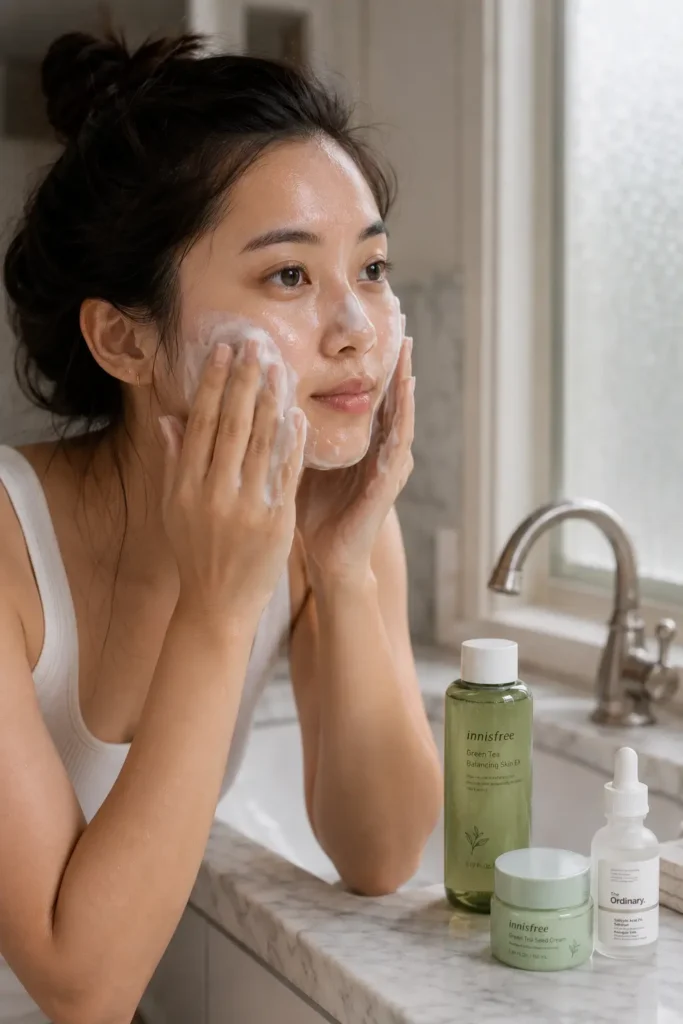
The temptation with oily skin is to strip it dry — but that actually triggers more oil production as the skin compensates. Instead, keep oil cleansing light (choose a gentle balm, not a heavy oil), use a gel or foam water-based cleanser, pick hydrating but lightweight products, and gravitate toward BHA exfoliants. Niacinamide and green tea-based toners and serums are excellent for controlling sebum. Choose a gel-cream or water-cream moisturizer rather than a thick cream. For sunscreen, look for matte-finish, dry-touch formulas. Gentle exfoliation 2–3 times a week helps keep pores clear without over-stimulating oil glands.
🌸 For Dry Skin
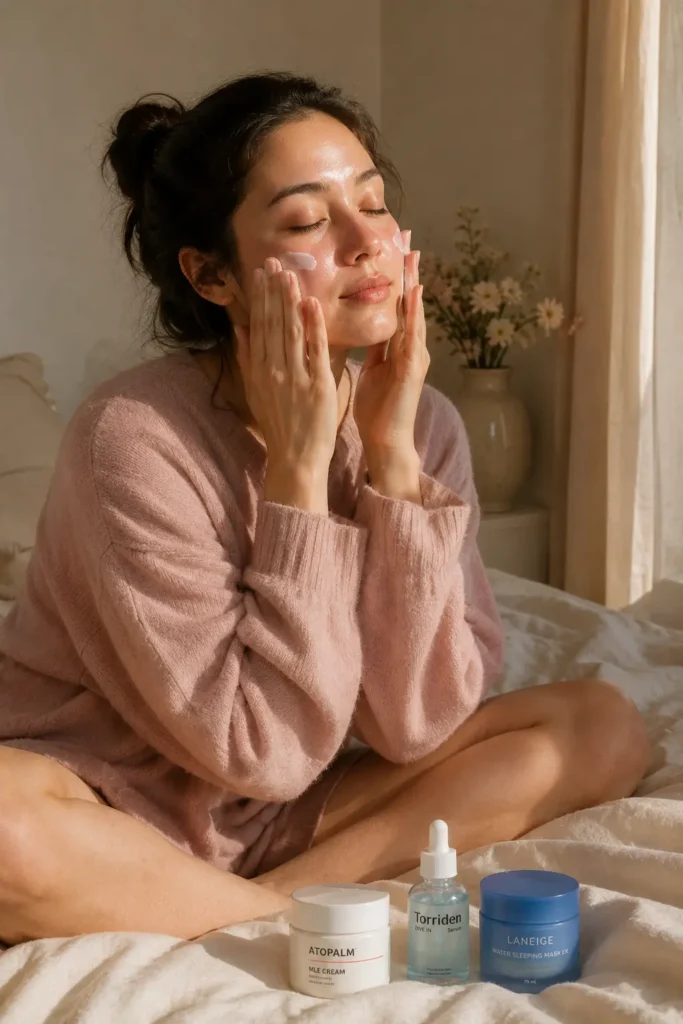
Dry skin is all about adding moisture at every possible opportunity. Use a rich, nourishing oil cleanser (shea or marula oil-based). Apply toner in 3–5 layers. Choose a hydrating essence with hyaluronic acid. Go for a deeply moisturizing serum with ceramides or squalane. Use sheet masks 3 times a week. Finish your PM routine with a thick cream or sleeping mask — Korean sleeping masks were practically invented for dry skin types. Look for ingredients like shea butter, ceramides, peptides, and honey extract throughout your routine.
🌺 For Sensitive Skin
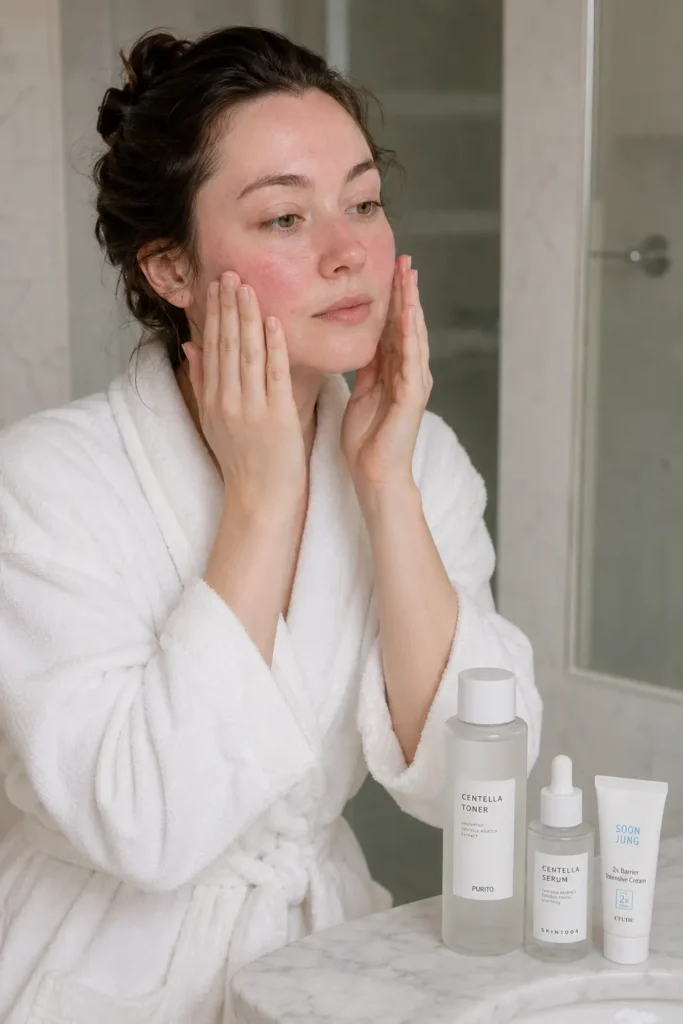
Sensitive skin needs the most cautious approach to K-beauty. Strip the routine back to its gentlest essentials: cleanse with a cream-based, fragrance-free formula. Avoid exfoliating until your skin is stable, then introduce PHAs gently. Build your routine around centella asiatica, allantoin, and panthenol (vitamin B5) — the holy trinity of sensitive skin ingredients. Always patch test every new product for at least 24–48 hours before full application. Fragrance-free, alcohol-free formulas are non-negotiable. Check out our article on skincare mistakes that could be damaging your skin — many apply specifically to sensitive skin.
💎 For Acne-Prone Skin
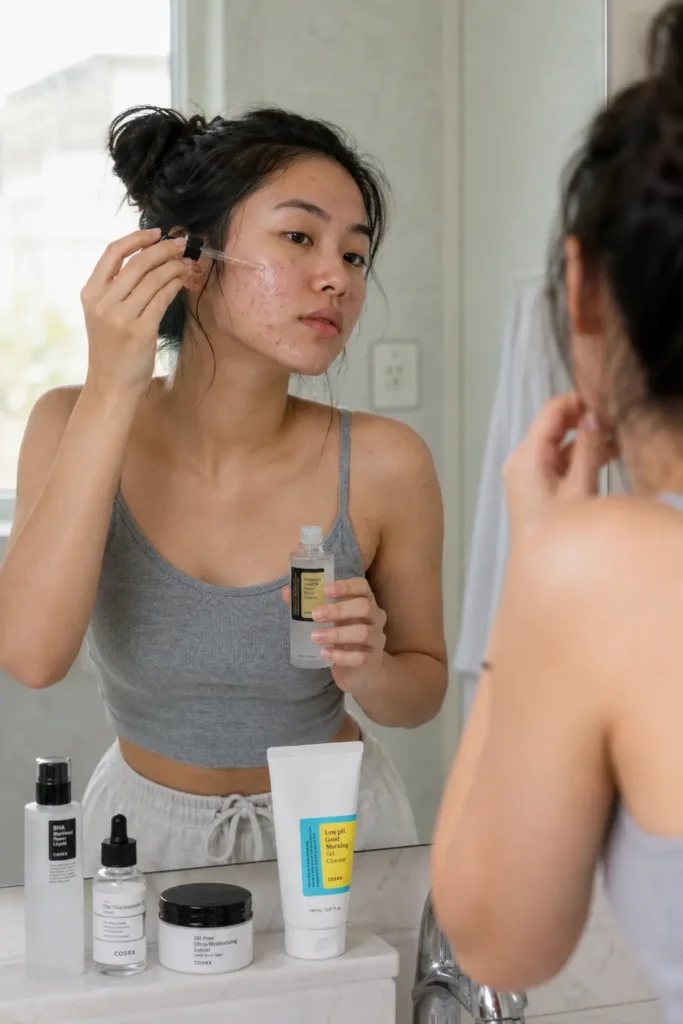
K-beauty is remarkably well-suited for acne-prone skin when done correctly. Double cleansing keeps pores clean without triggering inflammation. BHA exfoliants (2% salicylic acid) are your best friend for keeping pores clear. Look for serums with tea tree oil, centella asiatica, niacinamide, or azelaic acid. COSRX’s snail mucin essence and centella-based products have a near-legendary reputation in the acne community for reducing scarring and inflammation simultaneously. Choose non-comedogenic moisturizers and finish with a lightweight, broad-spectrum SPF.
🌈 For Combination Skin
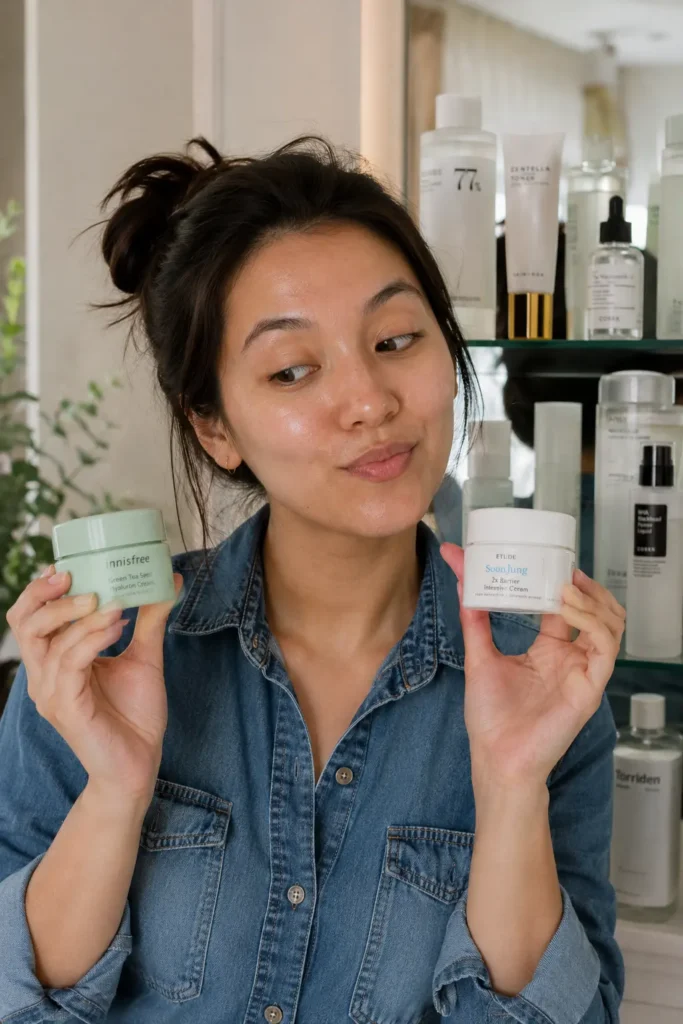
Combination skin requires a zone-based approach in some cases — using lighter gel-based products on the T-zone and slightly richer formulas on dry cheeks. Hydrating toners applied generously help balance the entire face. Look for multitasking ingredients like niacinamide that address both oil control and hydration. Layering is your advantage — you can apply an extra layer of essence to drier areas without adding excess product to oily zones.
👑 For Mature Skin
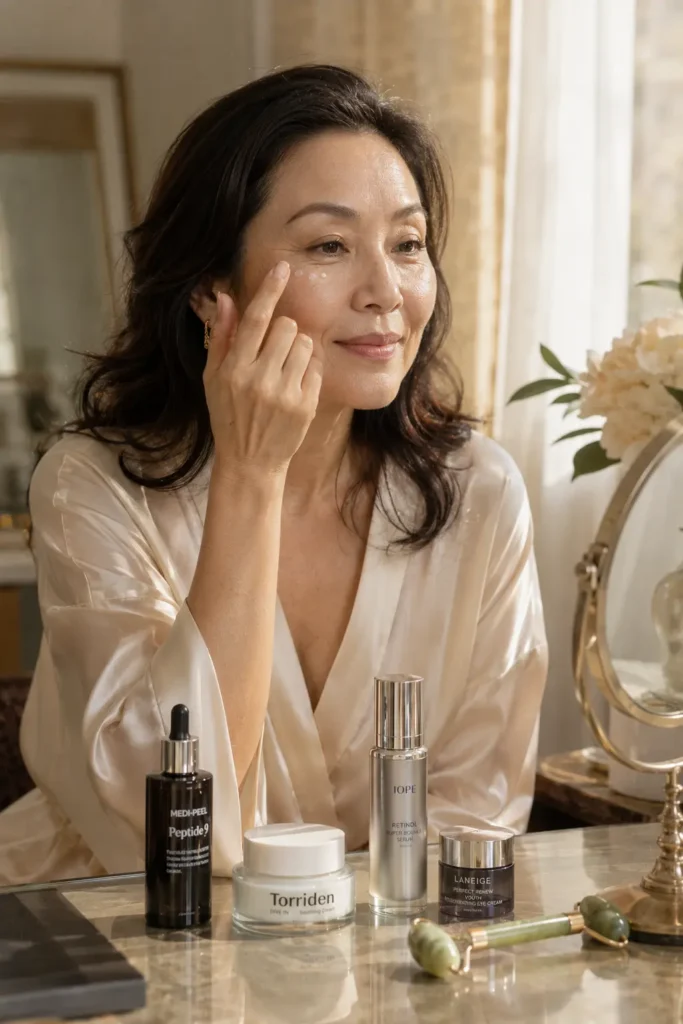
Mature skin craves consistency and nourishment. The K-beauty emphasis on hydration is perfectly aligned with what aging skin needs: ceramide-rich moisturizers, peptide serums that support collagen production, and AHA exfoliants that accelerate cell turnover. Look for fermented ingredients (galactomyces, bifida ferment lysate) which have excellent anti-aging profiles. The gentle, layering approach of K-beauty is far kinder to mature skin than aggressive retinol or acid treatments — though low-percentage retinol (0.1–0.3%) used consistently is absolutely worth incorporating into the PM routine.
Common Korean Skincare Mistakes Beginners Make
Starting any new skincare routine comes with a learning curve, and Korean skincare is no exception. Here are the most common errors people make — and how to avoid them from the start:
❌ Over-Exfoliating
This is probably the #1 mistake and one that causes real, sometimes lasting damage. The logic feels intuitive: more exfoliation = clearer skin. But the opposite is true. Over-exfoliating strips the skin’s protective acid mantle, destroys healthy cells along with dead ones, weakens the moisture barrier, and can trigger a cycle of excessive dryness followed by reactive oil production and breakouts. Two to three times per week is the maximum, and if you’re new to chemical exfoliants, start with once per week and build slowly.
❌ Introducing Too Many Products Too Quickly
The excitement of building a new K-beauty shelfie is real — but buying 8 new products and trying them all in one week is a recipe for disaster. If your skin reacts badly, you won’t know which product caused it. The golden rule: introduce one new product at a time, every 1–2 weeks, allowing you to track how your skin responds before adding the next one.
❌ Skipping Sunscreen
We cannot stress this enough. Every single skincare investment you make is being partially undone every day you go without SPF. UV damage accumulates over time, often invisibly until years later when it shows up as hyperpigmentation, wrinkles, or uneven texture. Sunscreen is not optional in K-beauty. It is the foundation.
❌ Mixing Incompatible Active Ingredients
Not all active ingredients play nicely together. Vitamin C + niacinamide in high concentrations can reduce each other’s efficacy. Retinol + AHAs/BHAs can cause severe irritation. Benzoyl peroxide + retinol deactivates the retinol. Before layering multiple actives, research their compatibility or consult a resource like INCI Decoder to check ingredient interactions.
❌ Skipping Patch Tests
Even gentle K-beauty formulas can cause reactions in certain individuals. Always apply a small amount of a new product to the inside of your wrist or behind your ear and wait 24–48 hours before using it on your face. This simple step can save you from a full-face reaction.
❌ Expecting Overnight Results
Korean skincare is a long game. Skin cells turn over approximately every 28 days (longer in older skin), so most products need at least 4–8 weeks of consistent use before you’ll see meaningful results. The glass skin you see on your favorite K-drama star took years of consistent routine maintenance — not two weeks of sheet masking.
Korean Beauty Trends in 2026
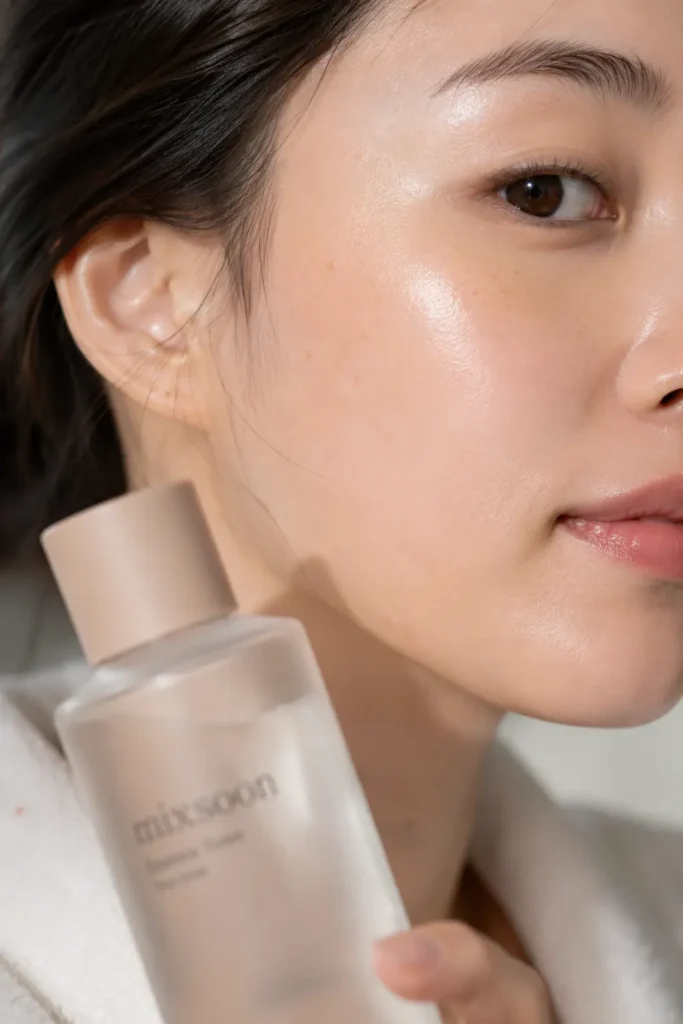
K-beauty is never static. The industry is constantly evolving, responding to new scientific discoveries, shifting consumer values, and changing beauty ideals. Here’s what’s shaping Korean skincare in 2026:
Glass Skin — Refined, Not Abandoned
The glass skin aesthetic remains the gold standard of K-beauty, but in 2026, the approach has matured. Rather than chasing a heavily filtered, ultra-gloss look, the focus has shifted to genuine skin health that creates natural luminosity from within. Bridal beauty trends reflect this too — brides are increasingly opting for healthy, radiant skin over heavy coverage.
Intentional Minimalism — Fewer Steps, Smarter Formulas
Korean cosmetic innovation in 2026 is centered on the philosophy of “skincare editing” — every product must earn its place with multiple high-performance functions. The trend toward multi-active formulations means you can get the benefits of 3–4 separate products in a single well-formulated step. For busy lifestyles, this is genuinely exciting: quality over quantity is now the K-beauty standard.
Skin Barrier Repair — The Priority Above All
Over-cleansing, over-exfoliating, and stacking too many actives are now recognized as contributors to inflammation and premature aging. In response, K-beauty brands have doubled down on barrier-repairing formulas. Ceramide-rich creams, barrier serums, and gentle acid exfoliants have replaced the aggressive actives trend of previous years.
Sustainable and Clean Beauty
There is a clear rise in vegan, cruelty-free, and eco-friendly solutions that appeal to modern values. Korean brands are investing heavily in sustainable packaging, biodegradable materials, and transparent supply chains. Powder cleansers and concentrated essences reduce both water usage and shipping waste — innovations that are catching on globally.
AI-Powered Skincare Analysis
AI-generated skincare routines represent the future of K-beauty — hyper-personalization rather than mass marketing. Several Korean brands now offer app-based skin analysis tools that photograph your skin, identify concerns, and recommend specific products. This technology is bringing genuinely personalized skincare to the consumer level for the first time.
Biotech Ingredients
PDRN (polydeoxyribonucleotide, sometimes called “salmon DNA”), exosomes, and lab-grown alternatives to traditional animal-derived ingredients are making their way from Korean dermatology clinics into at-home skincare. These next-generation actives promise clinic-level results at a fraction of the cost.
Best Korean Skincare Products Beginners Can Try
You don’t need to spend a fortune to experience the transformative effects of a Korean skincare routine. Here’s a beginner-friendly breakdown by category:
| Category | What to Look For | Beginner-Friendly Brands |
|---|---|---|
| Oil Cleansers | Emulsifies with water, fragrance-free, no mineral oil | Banila Co Clean It Zero, DHC Deep Cleansing Oil |
| Water Cleansers | Low pH (5–6), non-stripping, gentle foam | COSRX Low pH Good Morning Cleanser, CeraVe Hydrating Cleanser |
| Toners | No alcohol, hydrating formula, hyaluronic acid or glycerin | Klairs Supple Preparation Toner, Some By Mi AHA•BHA•PHA |
| Essences | Fermented extracts, watery texture, fast-absorbing | MISSHA Time Revolution, COSRX Advanced Snail 96 |
| Serums | Targeted to your concern, one key active per serum | Isntree C-Niacin Toning Ampoule, COSRX Niacinamide 15% Serum |
| Sheet Masks | Bio-cellulose material, hyaluronic acid, no fragrance | Mediheal N.M.F., Dr.Jart+ Dermask, Benton Snail Bee |
| Moisturizers | Non-comedogenic, ceramide or hyaluronic acid base | COSRX Oil-Free Ultra-Moisturizing Lotion, Laneige Water Bank Cream |
| Sunscreens | SPF 50+, PA++++, no white cast, lightweight finish | Beauty of Joseon Relief Sun, Isntree Hyaluronic Acid Watery Sun Gel |
Morning vs. Night Korean Skincare Routine
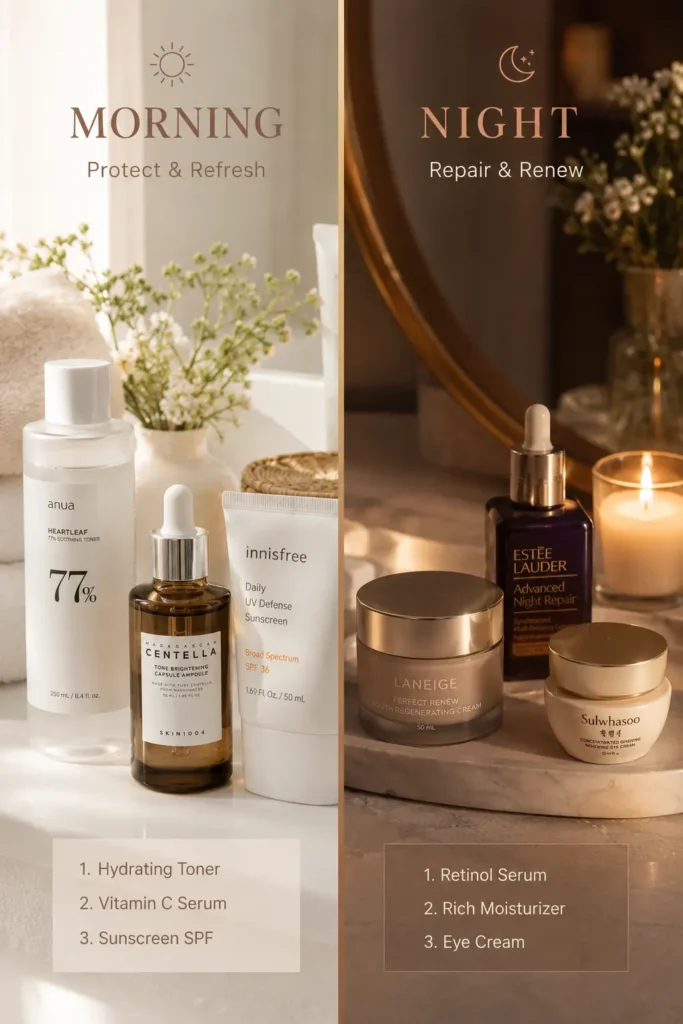
You absolutely do not need to do all 10 steps twice a day. The full 10-step routine is a menu, not a mandate. Here’s how to divide it intelligently between morning and evening:
| Step | Morning Routine | Night Routine |
|---|---|---|
| Oil Cleanse | Optional (rinse face or light cleanse) | ✅ Essential |
| Water Cleanser | ✅ Gentle cleanser | ✅ After oil cleanse |
| Exfoliator | ❌ Skip in AM | ✅ 2–3x per week |
| Toner | ✅ | ✅ |
| Essence | ✅ | ✅ |
| Serum | Antioxidant/brightening (Vitamin C or Niacinamide) | Repair/targeted (Retinol, peptides, AHA) |
| Sheet Mask | ❌ (time-consuming) | ✅ 2–3x per week |
| Eye Cream | ✅ | ✅ |
| Moisturizer | ✅ Lighter formula | ✅ Richer formula or sleeping mask |
| Sunscreen | ✅ Non-negotiable final step | ❌ Skip at night |
For Busy Lifestyles: The Simplified K-Beauty Approach
Not everyone has 20 minutes morning and night. Here’s the honest truth: a simplified routine done consistently will outperform a comprehensive routine done sporadically. A realistic minimum-effective routine:
Morning (5 minutes): Gentle cleanser → Hydrating toner → Vitamin C or niacinamide serum → Light moisturizer → Sunscreen SPF 50
Night (7 minutes): Oil cleanser → Gentle cleanser → Hydrating toner → Treatment serum → Moisturizer or sleeping mask
That’s it. Consistent, gentle, and effective — and it covers all the essentials of Korean skincare philosophy without requiring a dedicated vanity room and an hour of your day.
Frequently Asked Questions About Korean Skincare
❓ What is the Korean 10-step skincare routine?
The Korean 10-step skincare routine is a layered approach to skin health that includes: oil cleanser, water-based cleanser, exfoliator, toner, essence, serum or ampoule, sheet mask, eye cream, moisturizer, and sunscreen. Each step serves a specific purpose and builds on the previous one to create deeply hydrated, healthy, glowing skin over time.
❓ Do I need to do all 10 steps every day?
No — and even Korean skincare experts don’t recommend doing all 10 steps twice daily. The sheet mask and exfoliator are used just 2–3 times per week. In the morning, a simplified 5-step routine (cleanse, tone, serum, moisturizer, sunscreen) is perfectly effective. The 10-step framework is a complete toolkit — you choose the right tools for each occasion.
❓ Which Korean skincare step is most important?
Dermatologists and K-beauty experts universally agree: sunscreen. Daily SPF protects against the UV damage responsible for the majority of visible aging. After sunscreen, consistent cleansing and a good moisturizer form the non-negotiable core. Every other step is beneficial, but these three alone will transform your skin over time.
❓ How long does Korean skincare take to show results?
Meaningful results typically appear after 4–8 weeks of consistent use. Skin cells take approximately 28 days to complete their natural turnover cycle, so you need to give products at least that long before judging their effectiveness. Hydration improvements can be seen in days, but concerns like hyperpigmentation, acne scarring, and fine lines require longer commitment — often 3–6 months of consistent routine maintenance.
❓ Is Korean skincare good for acne-prone skin?
Yes — K-beauty is particularly well-suited for acne-prone skin when done correctly. The emphasis on gentle cleansing, non-comedogenic hydration, and BHA exfoliants (like salicylic acid) directly addresses the root causes of acne. Ingredients like centella asiatica, snail mucin, and niacinamide actively help reduce inflammation, heal existing blemishes, and fade post-acne marks. Many people with persistent acne find K-beauty more effective and less damaging than aggressive Western acne treatments.
❓ Can beginners start with fewer products?
Absolutely, and this is actually the recommended approach. Starting with 4–5 core products — cleanser, toner, one serum, moisturizer, and sunscreen — allows you to build your routine slowly and track how your skin responds. Adding products one at a time, with 1–2 weeks between introductions, prevents skin overload and helps you identify what’s working. Korean skincare is ultimately about consistency over quantity.
❓ Why is sunscreen so important in Korean skincare?
UV exposure is responsible for up to 90% of visible premature skin aging, including wrinkles, dark spots, and uneven texture. In Korean beauty culture, daily sunscreen application from a young age is as routine as brushing your teeth — and it explains, in large part, why Korean skin appears to age so gracefully. Every product in your routine is an investment that daily SPF helps protect.
❓ What is “glass skin” in K-beauty?
Glass skin (chok-chok in Korean) refers to skin so clear, smooth, and luminous that it resembles polished glass — reflective, dewy, and almost translucent. It’s not achieved through makeup or filters, but through consistent long-term skincare focused on deep hydration, gentle exfoliation, and a well-maintained skin barrier. The glass skin trend is the visual representation of what Korean skincare philosophy produces over time.
Final Thoughts: Your Korean Skincare Journey Starts Here
Here’s what it really comes down to: Korean skincare isn’t a rigid set of rules you must follow perfectly — it’s a philosophy about treating your skin with consistent, thoughtful care. Whether you adopt all 10 steps or build a simplified 5-step routine that fits your lifestyle, the principles remain the same: cleanse gently, hydrate generously, protect diligently, and be patient with the process.
Your skin is unique. Your routine should be too. Start small, learn your skin’s needs, introduce products gradually, and pay attention to how your skin responds. The Korean beauty approach doesn’t promise overnight miracles — it promises something far more valuable: genuinely healthy, resilient skin that improves with each passing season.
The glass skin aesthetic that has captivated the world isn’t about being born with perfect skin. It’s about making the daily choice, product by product and step by step, to take care of the skin you have. And that choice is available to every single person, regardless of skin type, age, or background.
Browse our full skincare guide collection and our beauty articles for more tips, product recommendations, and expert skincare advice. Your glow-up is entirely possible — it just starts with one step.
References: American Academy of Dermatology – Sunscreen FAQ | PubMed – Korean Skincare Ingredients Research | NCBI – Fermented Skincare Efficacy | NCBI – Skin Barrier and Hydration Science